
Corporate Tax Services in Malaysia
Company and personal tax computations prepared by chartered accountants — with an indication of the position well before it falls due.
What we prepare
- Form C — company income tax return, with the full tax computation and capital allowance schedules, due within seven months of financial year end.
- CP204 and CP204A — the tax estimate submitted before the basis period starts, and the revisions allowed during the year.
- Form E and EA forms — the employer return and the statements your staff need for their own filing.
- Form BE and Form B — personal returns for directors, sole proprietors and partners.
- Form P — partnership returns and the allocation of income to each partner.
- LHDN correspondence — we draft your responses to queries, audits and appeals, and handle the technical detail with you.
Capital allowances and the SME rate
Two things cost Malaysian SMEs the most money at filing time, and both are avoidable.
The first is under-claimed capital allowances. Plant, machinery, motor vehicles, renovations and computer equipment all attract initial and annual allowances under Schedule 3, and small-value assets can often be written off in full. We maintain a running capital allowance schedule as part of the year's work rather than reconstructing it in a rush at filing time — which is when items get missed.
The second is the SME preferential rate. A resident company that meets the paid-up capital test and the other statutory conditions pays a lower rate on the first slice of chargeable income. The conditions include group-shareholding restrictions that catch owners by surprise when they set up a second company. If you're planning a new entity, tell us before you incorporate — the structure decision is much cheaper to get right than to unwind.
Getting the CP204 estimate right
CP204 is where the penalties come from. Estimate too low and you're exposed to a penalty on the shortfall when the actual liability lands; estimate too high and you've handed LHDN an interest-free loan of your working capital for a year.
Because we're doing your monthly bookkeeping, we can run the estimate off real numbers rather than last year's figure plus a guess, and revise it in the months the law allows if trading changes. You'll get a projected tax position during the third quarter — while there's still time to do something about it.
Tax planning, not tax avoidance
We will identify the reliefs, allowances and incentives available to the company, how to structure director remuneration between salary and dividend, and when a purchase is worth bringing forward into the current year. We will not help anyone under-declare income or invent expenses — apart from being illegal, it's the fastest way to a field audit that costs far more than it saved.
Deadlines we track for you
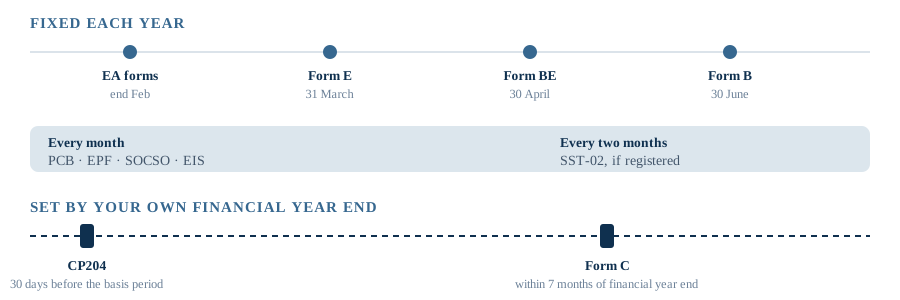
- Form C — seven months after financial year end.
- CP204 — 30 days before the start of the basis period.
- Form E — 31 March each year, with EA forms to staff by the end of February.
- Form BE — 30 April for individuals without business income; Form B 30 June with business income.
Every client's dates sit in a compliance calendar reviewed monthly, and are raised with you ahead of the deadline.
The figures and dates on this page describe the general position and are not advice for your specific circumstances. Speak to us about your own case before acting.
Tax questions from business owners
My company made a loss. Do I still need to file?
What happens if I've missed a filing deadline?
Should I pay myself a salary or a dividend?
Do you handle tax for Singapore-linked businesses?
Know your tax position before it's due
Bring last year's Form C and we will review the treatment adopted.