
The Sdn Bhd compliance calendar: every date you must diarise
Most penalties we see are not the result of anyone deciding to ignore a deadline. They happen because the dates are scattered across two different agencies, and half of them move depending on when your financial year ends.
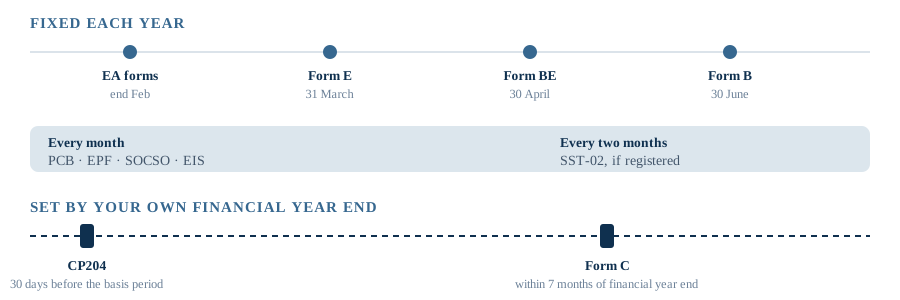
The dates that move with your year end
These are the ones that catch people out. They are not fixed months — they are calculated from your own financial year end (FYE), so two companies can have completely different deadlines for the same filing.
CP204 — tax estimate
Due 30 days before the start of the basis period. So it is submitted before the year it relates to, not after. This is the one most new directors do not know exists, and it is where penalties tend to originate, because the estimate also has to be reasonably accurate.
Newly incorporated companies get a different treatment for their first basis periods. If you have just set up, ask specifically about this rather than assuming the rule applies from day one.
Form C — company income tax return
Due within seven months of your financial year end. A December FYE means July. A June FYE means January. The return has to be supported by a full tax computation, including capital allowance schedules — which is why the underlying accounts need to be finished well before the seven months are up.
A company files Form C every year regardless of whether it traded or made a profit. Dormant companies file. Loss-making companies file — and filing matters especially in a loss year, because unabsorbed losses and capital allowances carry forward only if they are properly claimed.
Audited financial statements and the annual return
Every Sdn Bhd must have its accounts audited, circulated to members, and lodged with SSM, and must file an annual return each year. Both sit on SSM's calendar rather than LHDN's, and both are driven by your own dates — the annual return by the anniversary of incorporation, the financial statements by your FYE.
The dates that are the same for everybody
These are fixed in the calendar year, which makes them easier — and means there is no excuse for missing them.
- EA forms to employees — end of February. Every employee needs their statement of remuneration in time to file their own return.
- Form E — 31 March. The employer's return. Required even if you have only one employee, and directors of a Sdn Bhd count.
- Form BE — 30 April. Personal return for individuals without business income.
- Form B — 30 June. Personal return where there is business income.
- Monthly: PCB, EPF, SOCSO and EIS. Payroll statutory deductions and contributions, remitted every month.
- Bi-monthly: SST-02. If you are SST registered, returns follow the two-month taxable period cycle.
Two practical traps
Changing your financial year end changes everything downstream. Companies sometimes shift their FYE to align with a parent or a seasonal cycle, without realising it moves the Form C deadline, creates an unusual basis period, and can affect the CP204 already submitted. It is a decision worth modelling before you file the change.
"The accounts aren't ready" is not a deadline extension. The statutory dates are unconnected to the state of your bookkeeping. If your records are six months behind, the Form C deadline does not move — you simply arrive at it unprepared. This is the single strongest argument for keeping the books current through the year rather than reconstructing them at year end.
What we do about it
Every client's dates go into a compliance calendar we review monthly. You hear from us before a deadline rather than after one, and the underlying bookkeeping is kept current so that the tax computation has something to be built from. The secretarial side — annual return, financial statement lodgement, resolutions — is carried out by C & C in our group and sits on the same calendar.
This note describes the general position for a Malaysian private limited company and is not advice for your specific circumstances. Deadlines and requirements change; the position at the date above may not be the position now. Speak to us about your own company before acting.
Not sure which dates apply to you?
Tell us your financial year end and we'll map out your filing calendar for the year.